Regulation · 3 min
US sues Utah to stop its gambling case against Kalshi
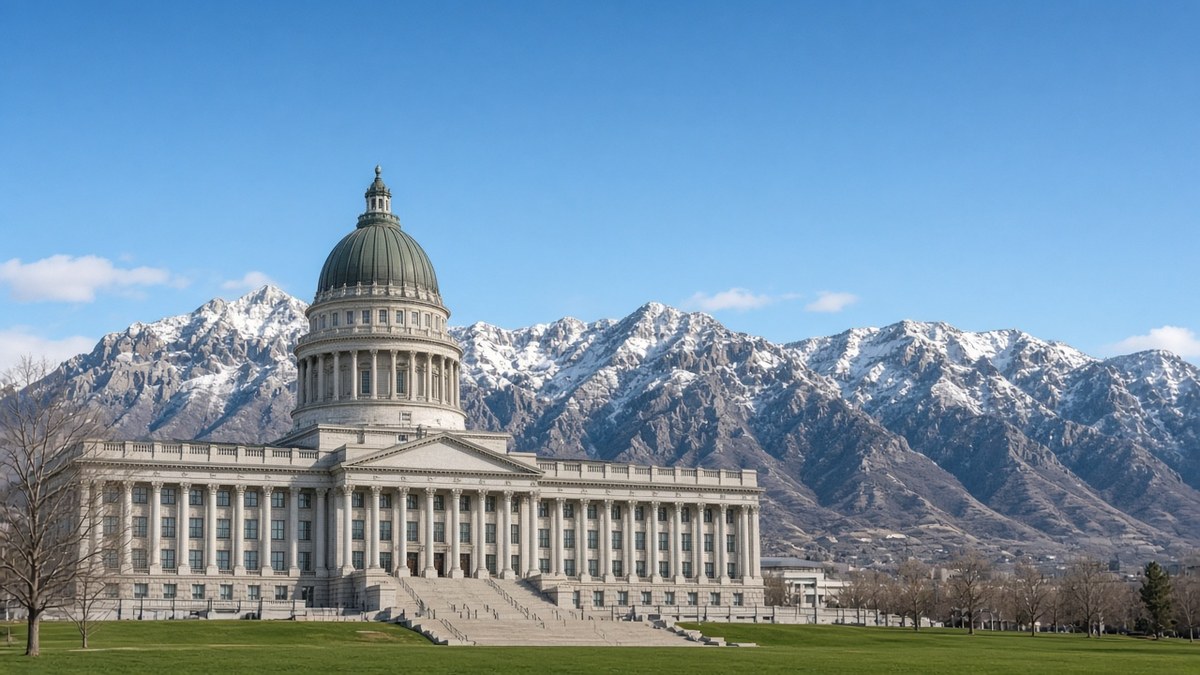
The Utah State Capitol in Salt Lake City, with the Wasatch mountains behind it. · Bonusjungle illustration
The United States and the CFTC have asked a federal court in Utah to declare Utah's gambling laws inapplicable to federally regulated prediction markets and to stop Utah's lawsuit against Kalshi. As of 28 October, no hearing date and no ruling have been reported.
The US federal government has taken Utah to court over prediction markets. On 26 October the United States and the Commodity Futures Trading Commission (CFTC), the federal regulator of futures and other derivatives, filed a lawsuit against the State of Utah and Attorney General Derek Brown in the US District Court for the District of Utah (case 2:26-cv-01055). They want the court to hold that Utah's gambling laws cannot be applied to exchanges the CFTC supervises, and to bar the state from investigating those exchanges or enforcing the laws against them. The CFTC announced the suit on 27 October.
"Utah seeks to shut down prediction markets across a wide variety of markets," CFTC Chairman Michael S. Selig said in the agency's release. "Congress entrusted the CFTC to be the federal regulator with sole responsibility to oversee these markets."
Newest casinos
Added:
Welcome offer: 400% up to €8,000
35× B+D · €25
Added:
Welcome offer: 450% up to €9,000
35× B+D · €25
Added:
Welcome offer: 100% up to €500
35× bonus · €20



18+ · Affiliate links. We may earn a commission.
What Utah did first
The federal suit answers a case Utah filed six days earlier. On 20 October Brown sued Kalshi, several Kalshi companies and two Susquehanna trading firms in state court in Salt Lake County (Brown v. Kalshi Inc., et al., No. 260908356). As the federal complaint quotes it, Utah says Kalshi began "offering gambling bets to Utah residents since at least September 2024" and that its bets are "indistinguishable from the bets of a traditional sportsbook." Utah also accuses Kalshi Trading and the Susquehanna firms, which it describes as market makers, of unlawful bets on the 2024 and 2026 elections.
Utah wants the state court to bar Kalshi from offering event contracts in Utah in categories including elections, politics, culture, sports and "mentions," and to recover what it calls unlawfully obtained profits. SBC Americas reports that the state estimates Kalshi collected $30.6 million to $61.2 million in fees from Utah accounts.
Utah's complaint says sports bets and other gambling bets are illegal under Utah law. In our view, the case is therefore not about which licence Kalshi needs, but about whether Kalshi may offer these contracts there at all.
What the federal government is asking for
Kalshi is a prediction market: customers buy and sell contracts that pay out according to whether an event happens, such as whether a team wins a game. The CFTC treats these event contracts as swaps traded on designated contract markets (DCMs), the federally registered exchanges under its supervision. Put simply, its argument is that federal derivatives law for these exchanges overrides state gambling law.
The two main requests in the complaint:
- a declaration that Utah's gambling laws, its ban on election betting and its public nuisance law are preempted by federal law and therefore cannot be applied to transactions on CFTC-regulated exchanges;
- a preliminary and then permanent injunction barring Utah from investigating CFTC-regulated entities "and their affiliates and partners" or enforcing those laws against them.
The CFTC says Utah's actions "threaten to wipe out the operation of CFTC-regulated exchanges in the state" and that the harm to the federal government would be "irreparable."
What has not happened yet
As of 28 October, the CFTC release, the complaint and the press do not give a hearing date or a ruling. The complaint filed on 26 October describes Utah's state case as pending.
Utah also goes into this case with an earlier win. According to SBC Americas, in a separate case Kalshi filed in February, a federal judge in the same district ruled for Utah on 4 August, holding that federal derivatives law does not override the state's gambling laws, and the Tenth Circuit denied Kalshi an injunction while the appeal is heard. That appeal is still open. SBC Americas notes that the CFTC complaint does not mention that ruling and instead cites decisions for the exchanges in other states.
Utah is not alone. The CFTC says it has also started legal proceedings against nine other states and filed briefs in four federal courts of appeal and one state supreme court. The same dispute is running in Louisiana, where Kalshi has sued in federal court over sports event contracts, and in New York, where the gaming commission has gone to court over Kalshi subpoenas. On the federal side, see the CFTC rule that casino and sportsbook wagers are not swaps and the NBA agreement that names Kalshi and Polymarket as preferred exchanges.
In our view, nothing in the law has changed yet for readers in Utah: as of 28 October the state still treats these contracts as gambling, and no ruling in the federal case has been reported.
Sources
- CFTC release 9315-26: CFTC Sues to Block State Enforcement in Utah Amid Ongoing Efforts to Preserve Jurisdiction (27 Oct 2026; Selig quote, nine other states)
- Complaint, United States and CFTC v. State of Utah and Derek Brown, D. Utah 2:26-cv-01055 (filed 26 Oct 2026; Utah's complaint quoted, relief sought)
- SBC Americas: CFTC claims 'irreparable' injury in lawsuit against Utah after state targeted Kalshi (27 Oct 2026; Utah's fee estimate, 4 August ruling and Tenth Circuit order)
- Gambling Insider: The Gambling Wire: CFTC Sues Utah as NBA Enters Prediction Markets (27 Oct 2026)