Analysis · 10 min
Same game, different rules: how states limit gambling, what it costs players and who earns from it
16 Nov 2026 ·
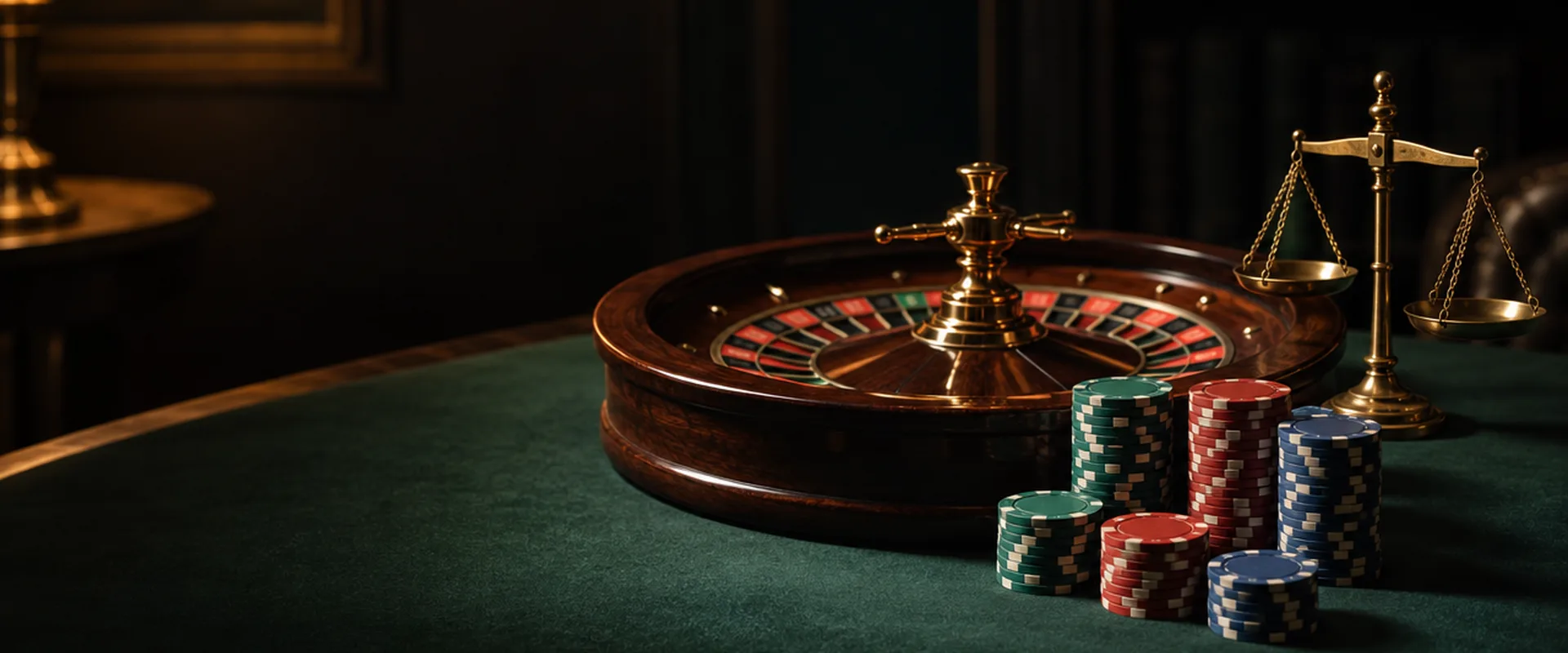
A roulette wheel and stacked casino chips on dark green felt beside a brass balance scale, lit by one warm lamp. · Bonusjungle illustration
We compared how 12 countries regulate online casino games and what they allow in their own casinos. In Germany we also counted: 776 games at one licensed site return about 87% to the player on average, where the maker lists 96.5% for the same game. Facts first, our opinion after, clearly marked.
Most countries now limit online gambling in the name of player protection. We wanted to know two things. Do the same limits apply where the state itself runs, licenses or taxes the game? And what do the limits cost the player in practice?
This report has two parts. Part one is facts, with sources. Part two is our opinion, and it is marked as opinion. Germany gets the closest look because it is the market we know best and because its rules are published in detail. It is one example among several, not the exception.
The short version
- Germany applies three different rulebooks to the same slot game, depending on where it stands: the private arcade, the licensed website or the state-licensed casino.
- Online, Germany taxes every stake at 5.3%. With the payout rates usual elsewhere, that sum does not add up, so German players get lower-paying versions of the same games.
- In our sample of 776 games at one German site, about 87% reaches the player on average. The maker lists 96.5% for one of those games.
- For the player, €100 lasts a little over an hour instead of almost four.
- The pattern is international. States tend to be strict where private firms offer the game and more generous where the state is owner, licensor or main earner.
Newest casinos
Added:
Welcome offer: 400% up to €8,000
35× B+D · €25
Added:
Welcome offer: 450% up to €9,000
35× B+D · €25
Added:
Welcome offer: 100% up to €500
35× bonus · €20


18+ · Affiliate links. We may earn a commission.
Group 1: One game, three rulebooks in Germany
The left and middle columns come from the law. Entries marked "our experience" are what we have seen ourselves as players and are not taken from a rulebook.
| Private arcade | Online, German licence | Casino (Spielbank) | |
|---|---|---|---|
| Maximum stake per game | €0.20 | €1; since July 2026 up to €5 on request | No figure in the law. The casino sets it. Our experience: usually €20, sometimes €50 |
| Speed | At least 5 seconds | At least 5 seconds | No rule found |
| Autoplay | No (our experience) | Banned | Yes (our experience) |
| Loss or deposit limit | €60 loss per hour | €1,000 in deposits per month | None found |
| Forced break | 5 minutes after one hour | 5 minutes after one hour | None found |
| Jackpots | Banned | Banned | No ban found |
Three notes on the table:
- The €1,000 limit counts deposits, not losses. Money withdrawn in the same month is not offset. The limit can be raised on request, up to €10,000 and in exceptions up to €30,000, according to the regulator's FAQ.
- The arcade rules do not apply to casinos. The trade law says so in terms (Section 33h of the Gewerbeordnung). In Bavaria, the casino sets its own minimum and maximum stakes and posts them at the table and the machine (Section 8 of the Spielbankordnung).
- The regulator has loosened the online stake itself. Since 1 July 2026 the Gemeinsame Glücksspielbehörde der Länder (GGL) allows up to €3 from age 21 and up to €5 after 90 days of play without warning signs, limited until the end of 2027. Operators do not have to offer it.
These rules are written by the 16 German states in their gambling treaty and by the federal tax law. The GGL applies them. It also publishes them in plain language, which is why we can compare them at all.
Group 2: The stake tax and the payout rate
Germany taxes online slot play at 5.3% of every stake, win or lose (Sections 37 and 38 of the Rennwett- und Lotteriegesetz). The tax base is the stake minus the tax, which comes to about 5 cents per euro staked.
| Per €1 staked | |
|---|---|
| Tax to the state | About 5 cents |
| What the operator keeps at a 96% payout rate | 4 cents |
| Result | A loss on every spin. The payout rate has to fall. |
Our sample: 776 games at one German site. On 16 November 2026 we read the table in which BingBong, a German-licensed site, publishes the payout rate (RTP) of every game it offers.
The operator writes, in our translation: "Most providers in Germany pass the 5.3% tax on to their players in a hidden way, by offering slots with a reduced payout rate." BingBong takes 7.2% of every win instead.
| Maker | Games | Listed payout rate (median) | Reaching the player after the 7.2% deduction |
|---|---|---|---|
| Novomatic (Greentube) | 163 | 90.1% | About 83.6% |
| Merkur | 110 | 94.1% | About 87.3% |
| Pragmatic Play | 56 | 94.5% | About 87.7% |
| All games | 776 | 94.0% | About 87.2% |
The right-hand column is our calculation (listed rate times 0.928), not the operator's figure. The weakest game comes to about 79%. After the deduction, 43% of the games are below 85%.
The same game, two rates. Pragmatic Play lists its standard payout rate on its own website.
| Game | Maker's standard rate | Reaching the player in our German sample |
|---|---|---|
| Gates of Olympus | 96.50% | About 87.7% |
| Sweet Bonanza | 96.48% | About 88.6% |
| Big Bass Bonanza | 96.71% | About 87.3% |
| The Dog House | 96.51% | About 88.6% |
Limits of the sample: it is one operator, not the market. We did not read a maker's standard rate for Novomatic or Merkur at the source. We have not yet counted a site that lowers the rate itself instead of deducting from wins.
Group 3: What it costs the player
All figures are expected values at 5 seconds per spin. They are our calculation. A single evening can go better or worse.
One evening: €100, €1 per spin
| Payout rate reaching the player | Playing time | Loss per €100 staked | Left after the money has been played through 20 times |
|---|---|---|---|
| 96.5% (maker's standard) | Almost 4 hours | €3.50 | €49.00 |
| 87.7% (our German sample) | 68 minutes | €12.30 | €7.20 |
| 80% | 42 minutes | €20.00 | €1.20 |
Playing time falls by a factor of 3.5. Because players keep playing with what comes back, the gap in what is left grows with every pass. After 20 passes it is almost sevenfold.
One month: €1,000, the German deposit limit
| Payout rate reaching the player | Playing time at €1 per spin | Playing time at €0.20 per spin |
|---|---|---|
| 96.5% (maker's standard) | 39.7 hours | 198 hours |
| 87.7% (our German sample) | 11.3 hours | 56.5 hours |
| 80% | 6.9 hours | 34.7 hours |
Where the €1,000 goes, with a 5.3% tax on every stake
| Payout rate reaching the player | Total staked from €1,000 | Tax | State's share of the player's loss |
|---|---|---|---|
| 96.5% (maker's standard) | €28,571 | About €1,440 | More than the whole loss |
| 87.7% (our German sample) | €8,130 | About €410 | 41% |
| 80% | €5,000 | About €250 | 25% |
The first row shows why the standard rate cannot be offered under a stake tax: the tax would be higher than everything the player loses. One caution: the tax row uses the statutory tax on stakes. The operator in our sample deducts from wins instead, so the amount that reaches the state there may differ.
Group 4: How other countries do it
The score for self-determination runs from 1 (the state decides almost everything) to 5 (the adult decides almost everything). It is our own assessment, not a measurement.
A. The state is the provider, or only its licensees may play online
| Country | Situation | Score |
|---|---|---|
| Norway | State monopoly. The regulator blocks other sites | 1 |
| Finland | Monopoly until 30 June 2027, licences from 1 July 2027 | 2 |
| Austria | One online concession today. A bill would open the market with deposit caps of €250 a week under 26 and €1,680 a month from 26 | 2 |
| Switzerland | Online only for land-based casinos with an extended concession | 2 |
B. Online casino banned, other gambling allowed
| Country | Situation | Score |
|---|---|---|
| France | Online casino games are not legal. Sports betting, horse racing and poker are | 2 |
| Australia | The Grattan Institute puts losses at A$1,635 per adult a year, the highest in the world, and says about 93% of the country's 185,000 poker machines stand outside casinos | 2 |
| Brazil | Since October 2026 a decree bans fixed-odds betting and online casino. Other lotteries allowed by law are exempt | 1 |
C. Allowed, with hard state limits
| Country | Situation | Score |
|---|---|---|
| Germany | See groups 1 to 3 | 2 |
| Netherlands | Checks from €700 net deposits a month. The regulator says licensed revenue fell 21% in 2025; the licensed share of revenue was an estimated 59% in the first half of 2026 | 3 |
| Italy | The 2027 budget bill plans €700m more from gambling | 3 |
D. The same rule everywhere, or the player decides
| Country | Situation | Score |
|---|---|---|
| United Kingdom | £5 per spin online, and £5 on casino slot machines (category B1) | 4 |
| Spain | From 26 March 2027 one default limit across all operators: €700 a day | 4 |
Group 5: The case for the limits
- Germany's regulator says it sees no valid signs that problem gambling has changed significantly since 2023. Supporters read that as the rules working.
- The German deposit limit is not absolute. It can be raised after checks.
- The United Kingdom shows that a state can apply the same stake limit online and in its casinos.
- A UK Gambling Commission study found that among people with repeated payments to suspected illegal sites, 45% of those surveyed scored as problem gamblers. Unregulated play is not harmless.
- Most black-market estimates come from the industry itself and should be read with care.
- Our payout sample is one operator.
Our view
This section is comment. It is the opinion of Bonusjungle.
In many countries, the state holds the bank. In a casino, the bank wins in the end. In gambling policy the state often sits in that seat. It writes the rules, hands out the seats at the table and takes a share of every game. In several countries it also plays. The stated reason is player protection, and we do not doubt that many people who write these rules mean it. But the results follow a pattern, and the pattern is about money as much as about risk.
The limits follow the money. If risk were the only measure, the same game would have the same limit everywhere. Norway keeps the game for its own company. France and Australia ban the online casino and keep taxing casinos and machines. Brazil closed private betting and exempted lotteries. Germany is strictest in the private arcade and most relaxed in the casino its states license. The risk to the player does not shrink because the carpet is thicker.
A stake tax makes the game worse. We think this is the most important finding. A tax on every stake leaves operators little choice but to sell players a lower-paying version of the same game: same name, same pictures, lower return. The loss in a game of chance is certain anyway. Under a stake tax the player gets far less playing time for the same loss. A player who loses faster is not better protected. As consumers, players in such a market are worse off than players of the same game elsewhere.
A deposit limit is not a loss limit. A limit that counts deposits treats the player who won, withdrew and wants to play again like the player who lost everything. We think a limit should protect the person who is losing.
What we have seen in casinos. In our own experience in German casinos, a guest can feed large notes into a machine, run autoplay at €20 a spin and place very large single bets at the roulette table, with no monthly limit. We are told staff are trained to watch for problem play. Online, a €1,000 limit applies to everyone, including players who are ahead. That is hard to explain by risk alone.
What we do not claim. We do not say limits are wrong. Online slots are fast, always available and dangerous for some people. We do not say there is bad faith behind every rule, and we do not blame the authorities who apply rules that parliaments wrote. We say this: whoever earns from the game should not be the only one who decides how much others may play.
Overview and our yardstick
| The claim | What we found | Group |
|---|---|---|
| Low stakes protect the player | €0.20 in the arcade, €1 online, no figure in the law for casinos | 1 |
| The monthly limit caps losses | It counts deposits. We found none for casinos | 1 |
| The tax is paid by operators | It is passed on through lower payout rates, as one operator says itself | 2 |
| Regulated games are fair value | About 87% reaches the player, against 96.5% for the same game | 2 |
| The rules slow the game down | €100 lasts 68 minutes instead of almost 4 hours | 3 |
| The state protects | With a stake tax, about 41 cents of every euro lost goes to the treasury | 3 |
| Online is the special danger | Where the state provides the game or taxes it on site, more is allowed | 4 |
Our yardstick
- Same game, same rule. What is too risky online cannot be unlimited in a casino.
- Tax the operator's revenue, not the stake. Then players get the same game as everyone else.
- Measure losses, not deposits.
- Let adults set their own limit, and apply it to every provider, state-owned ones included.
18+. Gambling can be addictive. If it stops being fun, see our responsible gambling page.
Sources
- Glücksspielstaatsvertrag 2021, Section 6c (deposit limit) and Section 22a (virtual slot rules) (primary; in German)
- GGL: FAQ on the deposit limit and the maximum stake (primary; stake tiers since 1 July 2026 and raised deposit limits; read 15 November 2026; in German)
- Spielverordnung, Section 13 (arcade machines) (primary; in German)
- Gewerbeordnung, Section 33h (casinos exempt) (primary; in German)
- Spielbankordnung Bayern, Section 8 (stakes) (primary; in German)
- Rennwett- und Lotteriegesetz, Section 38 (virtual slot tax) (primary; in German)
- GGL: statement on the 2025 gambling survey and the evaluation (primary; in German)
- BingBong: payout rates of all games (operator; 776 games and the quoted passage, read 16 November 2026; in German)
- Pragmatic Play: Gates of Olympus (maker; standard payout rate; the pages for Sweet Bonanza, Big Bass Bonanza and The Dog House give the other three rates)
- UK Gambling Commission: online slots stake limit guidance and gaming machine categories (primary)
- Grattan Institute: A better bet (2024) (think tank report; losses per adult and poker machine figures)
- The facts on other countries come from the stories linked above. Each of them lists its own sources.
- Statements marked "our experience" are the publisher's own observations as a player. Figures marked as our calculation are derived from the sources above.
Related